

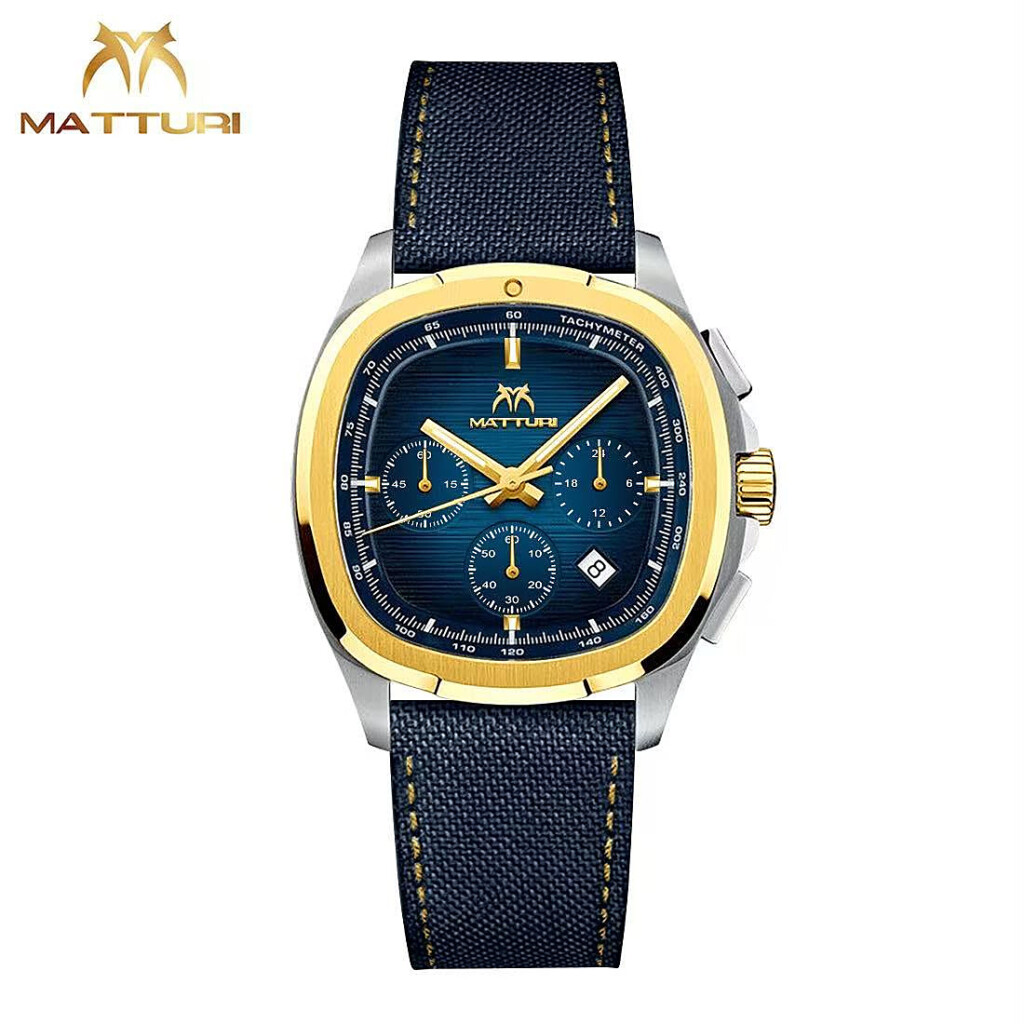
If you have ever looked at a watch with a few small dials on its face and two buttons on the side, you were looking at a chronograph. The name sounds technical, but the idea is simple: a chronograph is a watch that tells the time and also works as a stopwatch.
Here is what that means in practice, how to use one, and how to tell a working chronograph from one that only looks the part.
Chronograph watch meaning in one line
A chronograph is a watch with a built-in stopwatch. It still shows the hour and minute like any other watch, but you can also start, stop and reset a separate timer using the buttons on the side of the case. The word comes from the Greek chronos (time) and graph (to write), and chronographs have been around since the early 1800s.
What the small dials do
The small circles on the face are called sub-dials. On a working chronograph they show the time you have measured:
- The long centre hand usually counts the seconds of the timer once you start it.
- One sub-dial counts the minutes, often up to 30.
- Another sub-dial counts the hours, often up to 12.
- A third sub-dial, where there is one, often shows the running seconds of the ordinary clock.
Layouts differ from one watch to the next, so the exact job of each sub-dial varies. Some chronographs have two sub-dials and some have three.
How to use the stopwatch
- Check that the timer is at zero. The chronograph hands should all point straight up, to 12 o’clock.
- Press the top button, usually at 2 o’clock, to start the timer.
- Press the same button again to stop it, then read the time from the hands.
- Press the bottom button, usually at 4 o’clock, to send the hands back to zero.
On most chronographs you can also press the top button again to carry on timing from where you stopped, which is handy for timing something in stages.
What is a chronograph useful for?
You do not need to be a pilot or a racing driver. Everyday uses include timing a workout or a run, a cooking time, how long a meeting has been going, or how long you have been parked.
What is a tachymeter?
Many chronographs have a scale printed around the edge of the dial or on the bezel, marked tachymeter. It is used to work out speed over a known distance: you time how long it takes to cover one kilometre or mile, and the scale shows the speed per hour. In daily life most people never use it, and for many wearers it is simply part of the look.
Chronograph vs chronometer
These two words get mixed up all the time. A chronograph is about the stopwatch. A chronometer is a watch whose movement has been officially tested and certified for accuracy. A watch can be one, both or neither.
How to tell if the sub-dials really work
On many lower-priced watches the sub-dials are there for the design only. They look like a chronograph but do not measure anything. Before you buy, check these:
- Press the top button. On a working chronograph the timer hand starts to move. If nothing happens, the buttons and sub-dials may be decorative.
- Press the bottom button after stopping. The hands should return to zero.
- Read the description carefully. Look for words such as working chronograph, stopwatch function or functional sub-dials. If it only says chronograph style, or just lists sub-dials without saying what they do, ask.
- Ask the seller directly. A good seller will tell you straight whether the sub-dials work.
A watch with decorative sub-dials can still be a good watch. You simply should know what you are paying for.
Looking after a chronograph
- Do not press the buttons while the watch is wet or underwater unless the maker says it is designed for it. Water can get in through the buttons.
- Reset the timer to zero when you have finished with it.
- On a battery-powered (quartz) watch, leaving the stopwatch running can use more battery, so stop it when you are done.
Quick answers
Is a chronograph the same as a stopwatch? A chronograph is a watch with a stopwatch built in, so it does both jobs.
Do chronographs need winding or charging? It depends on the movement. Quartz watches use a battery, mechanical watches need winding, and automatic watches wind themselves as you move your wrist.
Can I wear a chronograph every day? Yes. Most people wear them as ordinary watches and use the stopwatch only when they need it.
Choosing your next watch
If you like the look of a chronograph, decide first whether you want to use the stopwatch or simply enjoy the style. Both are fine. Browse the full watch collection, and if you are not sure how a particular watch works, message us on WhatsApp. Wrist size matters too, so have a look at our guide to choosing the right watch size for your wrist.
Looking for a working one? Our MATTURI chronograph has working sub-dials and a tachymeter bezel, and comes in ten colour combinations, with free delivery in Lagos.